
Summarize with
Quick Answer: A solid outdoor lighting installation layers different types of light. Path lights keep people safe. Wall and accent lights build curb appeal. Motion sensor outdoor lights cover the entry points. Most homeowners pay $100 to $200 per installed fixture. Anything wired to the house needs a licensed electrician.
Introduction
By 4:30 PM in early December, the sun is already down in Massachusetts. Your steps and walkway sit in the dark for half the evening. Delivery drivers cannot find your house number. The fix is not more light. It is the right light in the right spots.
This guide covers fixture choices, real costs, and the permit rules that apply here. It also covers what New England winters do to outdoor hardware. Supreme Painters & Remodelers has 15+ years of experience on homes like yours. The advice below comes from that work.
Key Takeaways
- Plan the path first. Add accents second.
- Choose warm white bulbs and shield every light source.
- Low-voltage landscape lighting fits most paths and garden beds.
- Buy wet rated fixtures. Massachusetts weather is hard on hardware.
- Budget $100 to $200 per fixture when you estimate landscape lighting installation cost.
- Use a licensed electrician for anything tied to the house wiring.
Why Outdoor Lighting Installation Starts With a Plan
A plan decides where light goes before anyone buys a fixture. Skip it, and you get bright patches next to dark gaps. Walk your property after dark with a flashlight. Mark every step, turn, gate, and door. Those spots must be lit. Everything else is optional.
What Should Outdoor Lighting Actually Do?
It should show people where to step and who stands at the door. Looks come third.
- Safety covers steps, uneven pavers, and changes in grade. Security means visible entries and side gates. Curb appeal means picking one or two features worth showing off.
- Lot size matters in Greater Boston. Houses sit close together, and bedroom windows face each other. A bare floodlight can light up your neighbor’s room as well as your yard. Shielded fixtures fix that.
How Do Layers of Light Work Together?
Layered lighting stacks four kinds of light. Each one has a single job.
| Layer | Job | Typical spot |
|---|---|---|
| Path lighting | Shows the walking surface | Walks and driveway edges |
| Uplighting | Adds depth to trees and walls | Base of a tree or brick wall |
| Accent lighting | Highlights one feature | Garden beds and stone walls |
| Security lighting | Covers entries | Garage and side gate |
One bright floodlight alone creates harsh shadows. Layers fill those shadows in. Start with path lighting and add the rest as the budget allows. Order matters on a real job. Safety layers go in first because they prevent falls. Accent layers come last because they only add polish.
Which Outdoor Lighting Ideas for Front of House Work Best?
Light the walkway, the door, and one standout feature. Then stop.
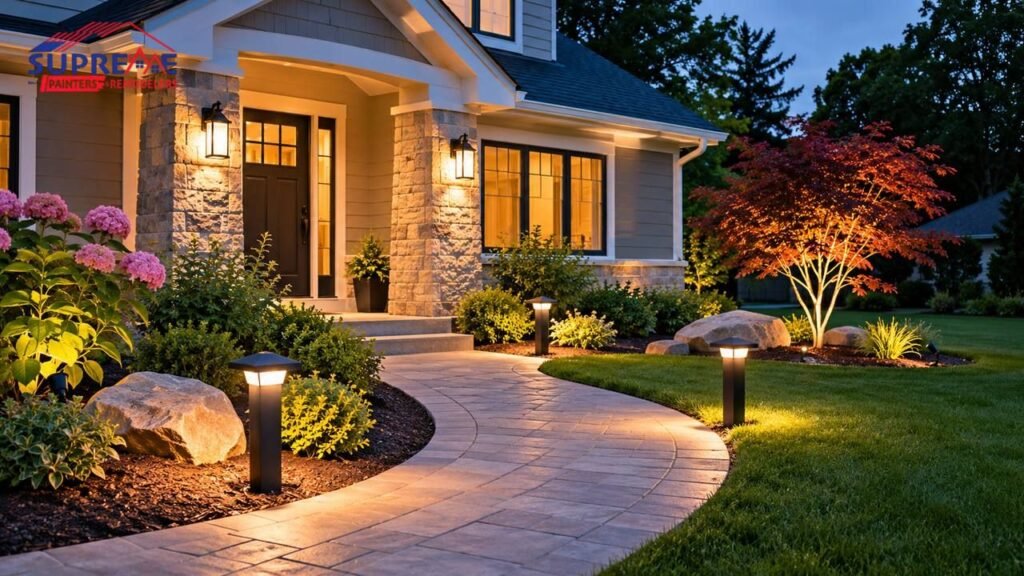
- Staggered path lights along the walk
- Step lights under each tread edge
- Two shielded wall lights beside the door
- One uplight on a tree or porch column
- A lit house number readable from the street
Skip the runway effect. That is what happens when identical lights sit directly across from each other. It looks like an airport.
| Tip: Most designers space path lights about 6 to 8 feet apart and stagger them. Check the look at night before you backfill any trench. |
Request a Lighting Quote
A plan only works when the fixtures match each layer. So let us pick them.
Choosing Fixtures for Safety and Security
Match every fixture to one job. Shielded lights handle walkways and sensor lights handle entries.
Which Fixtures Make Paths and Steps Safer?
Low shielded path lights and step lights work best. They show the surface without blinding anyone.
- Step lights deserve extra attention. A flat walk forgives mistakes. A stair edge does not.
- Massachusetts adds one wrinkle. Plows and shovels and snowbanks hit low stake lights hard. Pick cast aluminum or brass over thin plastic. Keep stakes out of the shovel zone along the driveway.
- Snow also reflects light. A fixture that looks right in July can glare in January. Choose dimmable bulbs so you can tone it down.
How Do Motion Sensor Outdoor Lights Improve Security?
A motion sensor switch turns on only when something moves. That sudden change gets noticed more than a light left on all night.
- The U.S. Department of Energy points to a motion sensor paired with a photosensor for security lighting. The light stays off in daylight and wakes up after dark.
- Aim sensors at your own entries. Point them away from the street. Passing cars and neighborhood cats will trigger them all night otherwise.
| Tip: Walk the sensor range at dusk before you lock in the mount. Adjust the angle until only your own yard sets it off. |
Lighting supports security but never guarantees it. Pair it with good locks and cameras.
What Does Wet Rated Mean for Outdoor Fixtures?
Wet rated fixtures handle direct rain and snow. Damp rated ones only suit covered spots like porch ceilings.
- Nor’easters push rain sideways under eaves. Road salt creeps onto steps and walls. A damp rated sconce on an open wall will fail early.
- Solid brass and copper handle salt better than painted steel. Choose 2700K warm white bulbs. The National Park Service recommends that warm range for most outdoor uses. Cool blue light looks harsh against brick and snow.
- Good fixtures still need the right power behind them. That brings us to voltage.
How Does Low Voltage Landscape Lighting Compare to Line Voltage?
Low voltage lighting runs at 12 volts through a transformer. It is easier to adjust and cheaper to run than line voltage.
What Is Low Voltage Landscape Lighting?
A transformer steps house power down to 12 volts. Thin cable carries it to LED fixtures in the yard.
- The cable needs only a shallow trench. You can move fixtures as shrubs grow. That flexibility is why installers favor it for paths and beds.
- Controls matter more than most people expect. The Department of Energy notes that a timer alone needs frequent resets as the seasons change. Boston daylight swings from about nine hours in December to over fifteen in June. A photocell handles that swing on its own.
When Does Line Voltage Make Sense?
Line voltage suits bright floods and wall lanterns and anything mounted on the house. It runs at 120 volts and needs an electrician. Most outdoor lighting installation jobs mix both types. Low voltage covers the yard. Line voltage covers the house. Older homes often lack a GFCI-protected outdoor circuit. One national cost guide puts that fix at $200 to $500. Budget for it before you shop for fixtures.
| Feature | Low voltage | Line voltage |
|---|---|---|
| Power | 12 volts | 120 volts |
| Best for | Paths, beds, and accents | Wall lanterns and floods |
| Trenching | Shallow cable runs | Deeper runs with conduit |
| Installer | Electrician for the transformer hookup | Licensed electrician |
| Cost per fixture | $100 to $150 | $100 to $200 |
How Does Exterior Light Fixture Installation Differ From Landscape Work?
Light fixture installation happens on the house. Landscape work happens in the soil.
- On the house, the job involves boxes, wires, and weather seals. Fixtures mount to siding or brick, or trim. Uneven siding calls for a mounting block so the fixture sits flat.
- Painting comes first. We paint the trim and the block before the fixture goes on. That saves you from taping around a live fixture.
- Live in a Boston historic district such as Beacon Hill? The Beacon Hill Architectural Commission reviews new light fixtures there. Ask before you buy.
- Voltage shapes the budget more than any other call. So let us talk numbers.
What Is the Real Landscape Lighting Installation Cost?
Most homeowners pay $2000 to $4500 for a typical yard. That works out to about $100 to $200 per installed fixture. A ten fixture outdoor lighting installation for a front walk and entry lands around $1000 to $2000 at those rates. Transformer upgrades and trenching can add to that.
Cost by Fixture Type
Pathway lights cost the least. Motion sensor security lights cost the most.
| Item | Typical installed cost |
|---|---|
| Pathway lights | $50 to $150 each |
| Low voltage fixtures | $100 to $150 each |
| Hardwired fixtures | $100 to $200 each |
| Outdoor wall lights | $50 to $250 each |
| Motion sensor security lights | $350 to $500 each |
| Electrician labor | $50 to $100 per hour |
These figures come from national cost guides at HomeAdvisor, Angi, and LawnStarter. Labor in the Boston area usually runs higher. Treat the table as a starting point and get written quotes.
What Pushes the Price Up or Down?
Trenching, transformer size, and fixture material move the price most. Fixture count matters less than people think. Digging through pavers or concrete costs extra. Long cable runs add cost too. Angi puts wiring at $2 to $4 per linear foot. Solid brass costs more than aluminum but lasts longer in salt. Season matters here. Frozen ground can stop trenching from about December through March. Spring and fall book up fast.
| Pro Tip: Ask every contractor for a written plan with the fixture count, transformer size, and cable length. Compare quotes line by line. A low bid that skips the transformer upgrade is not low. |
Do You Need an Electrician for Outdoor Lighting Installation?
Yes, for anything wired to the house. Plug-in kits and solar stakes are fair DIY.
- Electrical work in Massachusetts falls under the Massachusetts Electrical Code. That is 527 CMR 12.00. Permits go through your town’s wiring inspector. The state permit application asks about the licensee and their insurance coverage.
- Low voltage systems sit in a gray zone. Call your wiring inspector and ask before you dig. That one phone call prevents a failed inspection.
Still weighing details? These quick answers cover what homeowners ask most.
Frequently Asked Questions
What is the average cost of installing outdoor lighting?
Most yards land between $2000 and $4500. Large or complex yards can exceed $ 7,000. Cost depends on fixture count and type, trenching, and controls. Hardwired systems sit at the top of the range.
Do I need an electrician to install an outdoor light?
Yes, when the light connects to your home wiring. Solar and plug-in lights do not need one. Massachusetts treats wiring as licensed work under its electrical code. A licensed electrician also pulls the permit.
How much does an electrician charge to install an outside light?
Expect $50 to $100 per hour for labor. A single fixture usually runs $150 to $350 to install, before the fixture itself. Wiring runs add roughly $2 to $4 per foot. Boston area rates often sit above these national figures.
Can you install outdoor lighting yourself?
You can set up solar stakes and plug-in low voltage kits yourself. Do not wire anything into the house. Even a plug-in kit needs a GFCI-protected outlet. Test the outlet before you buy a transformer.
What is the rule of thumb for outdoor lighting?
Light only what you need and shield every source. Then layer path, accent, and security light. Space path lights about 6 to 8 feet apart. Use 2700K warm white bulbs. More fixtures rarely beat better placement.
Conclusion
Good outdoor lighting installation comes down to three calls. Plan the layers. Match fixtures to Massachusetts weather. Hire licensed help for anything wired to the house. Supreme Painters & Remodelers brings 15+ years of experience to every job. We plan the layout, paint the trim, and install fixtures built for New England winters. See our lighting services for details.
Check your fixtures every spring. Frost heave can push stakes up, and salt can eat connections. A ten minute walk-through now saves a repair bill later.
Ready to Light Up Your Home?
Supreme Painters & Remodelers plans and installs lighting that looks sharp and holds up through Massachusetts winters. Call (857) 326-5100 or email omar@supremepaintersremodelers.com to book a walkthrough.
Request Your Lighting Quote
Government sources
- Energy.gov lighting controls: Explains how motion sensors, photosensors, and timers cut outdoor lighting waste.
- National Park Service outdoor lighting principles: Sets out shielding and warm 2700K color guidance for outdoor fixtures.
- Mass.gov permit application for electrical work: The state form used to permit licensed electrical work in Massachusetts.