
Summarize with
Small dents, nail pops, and hairline cracks are usually safe DIY drywall repair projects in Abington, MA. Cracked corners, water-stained ceilings, or sagging sections almost always call in a drywall repair contractor instead.
The right answer in the DIY vs professional drywall repair debate comes down to three things: how big the damage is, what caused it, and how much risk you want to take on with your home’s walls. Abington homes built before 1960 are old with plaster behind the drywall.
Older homes are tricky to deal with. Newer homes are easy to repair.
This guide checks both options so you can choose what matches your situation, not only the one that looks cheaper right upfront, at first glance it seems.
Understanding the Core Distinction Between DIY and Professional Drywall Repair
Whether you need a professional depends on the depth of the damage. If the wall is damaged from the upper side, DIY can work, kind of. Just check it first, because if it’s more than superficial, things can get messy. Sometimes a quick fix is possible, but only when the damage is not serious. But if there is internal damage, take help from a professional. A scuff mark, a doorknob dent, or a screw pop is surface-level.
Small wall damage is low risk, low-cost, and easy to repair. Most owners can do it with basic tools within a single day. Repeated cracks and ceiling stains that spread after every heavy rain require deep fixation. Such deep fixation requires professionals.
DIY repairs are a good call for small dents, minor surface abrasions, and pretty thin cracks, you know. You can usually manage these kinds of fixes without a big procedure, a quick touch-up kinda work.
You only need basic tools such as joint compound, a putty knife, and sandpaper to repair. But the hardest job is matching the paint.
Moistured- damaged or structurally damaged walls cannot be handled by homeowners. Only a professional with all the tools can handle it. If there are loose corners, big holes, a sagging ceiling, or cracks that keep reappearing every year, there’s probably a deeper issue behind it, like something unseen.
Before fixing the wall, you should first find out what’s causing the issue. Like what’s really behind it, not just the look on the surface.
A South Shore home that is poorly ventilated can cause damage. Even at first, nothing looks worse.
DIY Drywall Repair in Abington, MA: What It Actually Involves
For small, purely cosmetic damage or broken corners, DIY wall repair is a good option. It is usually cheap. If wall damage is due to mold, or the framing is off, or the insulation is compromised, then it really isn’t a DIY kind of thing.
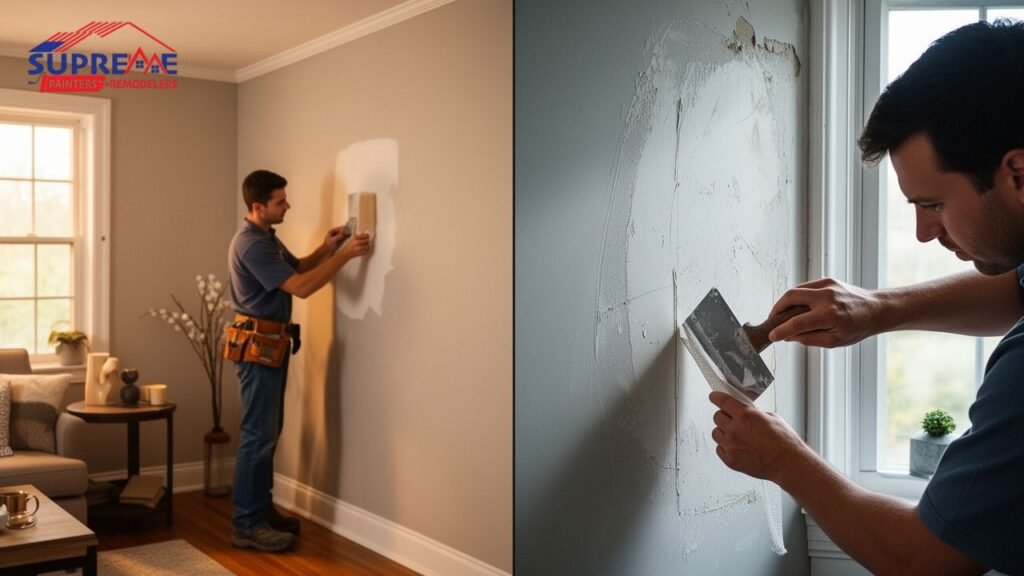
Most DIY work usually goes through some sort of the same basic sequence: you know, clean the area, then apply joint compound, or if it’s bigger than a pinhole, use a self-adhesive mesh patch, then wait for it to dry, sand it down until it’s smooth, and prime it before you start painting.
The tough part is not the patching. It’s matching the repaired part to the rest of the wall in old homes of Abington. Older homes have texture, which is very hard to cover perfectly unless you have expertise.
Paint sheen really matters, too. If you patch a flat wall, then repaint it in eggshell, you’ll see a noticeable halo under lamp light even when the repair underneath is genuinely smooth.
| Factor | DIY Drywall Repair | Professional Drywall Repair |
| Best suited for | Nail holes, small dents, single hairline cracks | Large holes, recurring cracks, water damage, sagging ceilings |
| Typical time investment | 1–3 hours per spot, plus dry time | Same-day to 1–2 days depending on scope |
| Skill/tool requirement | Basic — putty knife, sandpaper, compound | Taping, texture matching, sometimes framing or insulation work |
| Texture and paint match | Often visible, especially under raking light | Blended to match existing wall texture and sheen |
| Risk if underlying cause is missed | Damage returns, sometimes worse | Cause is diagnosed before the patch goes on |
The gap in that table isn’t really about who can hold a putty knife; most people can. It’s about what happens when the crack in the corner of your dining room comes back a third time, and you still don’t know why.
Professional Drywall Repair Services: When They’re Worth It
Professional drywall repair services are worth the money when damage is linked to moisture, a structural issue, or it is in a highly visible place. A drywall repair professional has two additional benefits that most owners lack: diagnostic experience and texture-matching skills.
Diagnosis matters more in old Abington homes than in nearby new homes. Most of the houses are old, so problems aren’t always as simple as they seem.
Most ceilings become damp in winters. A contractor working on older homes has probably seen this kind of problem many times. They will look closely at the problem instead of immediately trying to fix it.
Professional services cost you more, but it is long lasting. The repair material (compound) is spread out fairly smoothly over a wider area, and then it is blended in until it starts to fit the wall’s actual texture. Rather than correcting only one tiny spot, the repair is built to look more natural, almost like it was always there, and it should blend in seamlessly with the rest of the wall.
And if the wall was repaired already, the professional can explain pretty clearly whether the previous job is holding up well, or if it is really a weak repair.
Factors to Weigh Before Choosing DIY or a Contractor
- Size of the damage: If the damage area is larger than a dinner plate, or spreads across a large section of wall, a DIYer cannot do it.
- Whether it’s happened before: If a crack keeps reappearing, it is due to improper repair.
- Location on the wall or ceiling: When the damage hits those high-visibility places like entryways, vaulted ceilings, or accent walls, it can feel extra obvious, and well, it is not just small stuff. It is more noticeable.
- Time and tools on hand: It depends on which tools you use and how much experience you have. Professionals have years of practice to do it perfectly.
- Your comfort with the risk: If a DIY patch falls, it will cost you more. You have to pay for the failed material as well as for a professional fix.
Answers to Common Questions
Homeowners in Abington often ask which approach they should take. A common concern is whether a small DIY patch will actually hold up through winter or not, since temperature change puts pressure on the paint and results in cracking.
Is DIY drywall crack repair safe for hairline cracks?
Yes, for a small crack that hasn’t reopened before, a mesh tape patch and joint compound can do the work. But if the same crack returns within a season, it means there is some deeper issue.
How do I know if I need a drywall repair contractor instead of doing it myself?
If the damaged surface is more than a square foot, it involves the ceiling, or shows any water stains. Hiring a contractor is a safer option. Only covering the patch alone is not sufficient.
What does drywall repair typically cost for a residential job?
Small residential drywall repair things handled by a pro usually land in the low hundreds of dollars, while bigger or moisture-related repairs run even more, depending on how much drywall is needed, plus insulation, or maybe the whole texture process that has to be redone.
Getting that specific quote for your exact situation is the only reliable way to know the real number, not some guessed amount or whatever.
Can I match my home’s existing wall texture on my own?
It depends on the practice, as older Abington homes often have applied textures that are hard to cover with store-bought sprays. Because of this, DIY repairs often mismatch after painting.
Does homeowners insurance ever cover drywall repair?
If the damage happened suddenly, like from a burst pipe, your insurance might pay for the repair. But it depends on your specific policy, so it’s not always guaranteed. That’s why it’s better to call your insurance company and ask, instead of guessing.
Expert Advice for Abington Homeowners
The answer to DIY vs professional drywall repair isn’t “always DIY” or “always hire out”. It depends on the problem with the wall. A small patch can typically be done by a homeowner over a weekend.
Anything linked to moisture and anything on a ceiling or high-visibility wall is worth a second opinion before you reach for the joint compound. Getting that distinction right the first time saves both money and the frustration of patching the same spot twice.
Expert Support for Your Project
Supreme Painters & Remodelers handles everything from small cosmetic patches to full drywall repair and texture-matching after water damage, framing issues, or a previous repair gone wrong.
Contact Supreme Painters & Remodelers at (617) 888-9052 or email omar@supremepaintersremodelers.com to discuss your specific needs. Getting an honest check before you start is often what separates one good repair from three more annoying attempts that feel like a loop.