
Summarize with
The majority of homeowners enter a paint store with a color in mind. Very few of them are familiar with the type of coating behind that colour and this choice makes the difference between a job that lasts for five years and a job that lasts for twelve years.
Picking exterior house paint without understanding the base, the finish, and how your climate treats each one is how a repaint turns into a redo. We get called back most often not because a color faded, but because someone chose flat paint for a sun facing wall or oil based trim paint that cracked its first New England winter.
What Kind Of Paint Should You Use On A House Exterior?
Use 100% exterior house paint, acrylic latex base for siding. It is flexible to temperature changes, won’t chalk and can be wiped down with water.
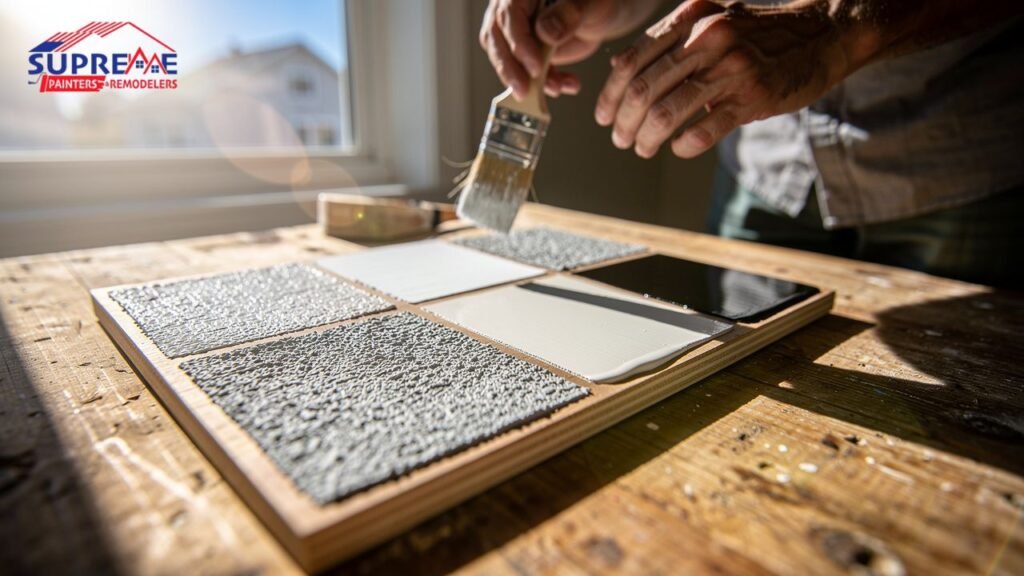
Exterior paint types can be divided into three, each of which covers almost all exterior surfaces: acrylic latex (for wood, vinyl, aluminum, and fiber cement) is acrylic paints that over time turn yellow but can be applied to almost any surface; oil based (alkyd) is oil based paints that are still found on older trim and railings, although they are prone to yellowing over time; elastomeric is a type of paint that is thick enough to cover hairline cracks and is used on stucco and masonry.
| Paint type | Best surfaces | Typical lifespan | What it doesn’t do well |
|---|---|---|---|
| 100% acrylic latex | Wood, vinyl, aluminum, fiber cement | 7 to 10 years on siding, 4 to 6 on trim | Bridging existing cracks without prep |
| Oil based (alkyd) | Metal railings, some older trim | 3 to 5 years before yellowing | Flexing with wide temperature swings |
| Elastomeric | Stucco, masonry, concrete | Up to 10 years in the right climate | Wood siding, anywhere moisture needs to escape |
What Paint Finish Is Best For A House Exterior?
Exterior paint finishes range from flat to left to absorb light and conceal surface imperfections, but collect dirt, to gloss, which repels water and dirt but reveals all imperfections below the surface.
The most work that is done on New England homes is with satin and eggshell. They are sufficiently tolerant to cover minute bumps and unevenness in clapboard and shingle siding, and stand up better to rain and mildew than flat paint.
Semi gloss is a surface that retains its luster when it’s touched, scrubbed, and rained on, and is ideal for trim, doors and shutters. Don’t use true gloss for every facade, only for a front door or to accentuate one place. It magnifies every seam in the siding.
| Sheen | Where it belongs | Why |
|---|---|---|
| Flat or matte | Rarely used on exteriors | Hard to clean, wears fastest in weather |
| Eggshell or satin | Siding, shingles, shutters | Hides surface flaws, sheds moisture better than flat |
| Semi gloss | Trim, doors, window frames | High traffic surfaces that need scrubbing and moisture resistance |
| Gloss | Front doors, small accents only | Very durable but shows every flaw at scale |
How Long Does Exterior Paint Actually Last?
A properly prepped acrylic latex job on siding runs 7 to 10 years. Trim wears faster, typically 4 to 6 years, because it takes more direct sun and water. That range moves a lot depending on one thing more than any other: prep work.
Painters spend most of a job scraping, sanding, priming bare spots, and caulking joints before a drop of finish coat goes on. Skip that stage and even premium paint fails in two or three years, peeling right back off primer that never bonded to the old surface.
Less direct UV exposure and thermal cycling tends to make north and east facing walls hold paint longer as compared to south facing walls in Massachusetts. It is not necessarily a failure if your south wall is chalking or fading before the other walls in your house.
What’s The Best Time Of Year To Paint A House Exterior In New England?
Expect days with temperatures in the 50 to 85 degrees, low humidity and no rain forecasted for at least the next 24 hours. That translates to late Spring to early Fall for most of Massachusetts and is an important consideration for exterior house painting in Massachusetts. Cold weather hinders the paint from drying correctly and can cause the paint to crack or peel in one season. In hot summer sun, on a dark colour wall, paint can dry more quickly than it levels creating lap marks where one part of the wall is painted over another.
Do You Need A License To Paint A House In Massachusetts?
Not for your own home. Hire it out, though, and the contractor needs a Home Improvement Contractor registration with the Massachusetts Office of Consumer Affairs and Business Regulation, checkable online before you sign. Pre-1978 house? The contractor also needs EPA lead safe certification, since Massachusetts runs its own version of that program. Ask for both.
Not every job needs a call, either. If your trim board is chipped or the area around the storm is damaged, you can do this yourself: scrape to a sound edge, spot prime and feather in with a matching coat.
It’s more important than finding the best exterior paint for homes built homes because a sheen mismatch will be visible in raking light regardless of the brand. Don’t call in for full elevations unless it’s one story or higher or if it involves lead risk, and invest in a durable exterior paint system, not to repeat patches.
How to Choose Exterior Paint for Your Home
- Match base to surface: 100% acrylic latex is recommended for wood, vinyl, aluminum and fiber cement siding as it will flex with temperature fluctuations and won’t chalk.
- However, if you still want a little more sheen for trim and railings, oil based paint will still work, but will turn yellow over time.
- Elastomeric coatings should only be applied to stuccoed or masonry surfaces and are designed to fill in hairline cracks, do not apply to wood siding as it will retain moisture the wood requires.
- Take a matching finish to the exposure: eggshell or satin will hold up over an entire elevation.
- Semi gloss belongs on doors and trim, the surfaces that take direct handling and rain
- Gloss should stay limited to small accents, since it magnifies every flaw in the surface underneath it
- Done right with proper prep, that combination holds for 7 to 10 years on siding before you’re back to choosing again
Getting It Right The First Time
House exterior painting succeeds or fails in the prep stage, long before anyone picks a paint brand. Scraping, priming, and caulking get skipped more often than not, and that’s exactly what shows up as peeling in year two instead of year eight.
Supreme Painters & Remodelers does that work properly, then matches a 100% acrylic latex system to your siding and sun exposure, not a one size fits all recommendation off the shelf.
Call (617) 888-9052 or omar@supremepainters remodelers.com for a walk through of your home’s exposure and a finish plan built around it.
Frequently asked questions
Is it necessary to prime before exterior house painting?
Yes, on any bare wood, patched area or surface where the old paint was completely removed. The new topcoat absorbs unevenly, resulting in a blotchy finish and weaker adhesion—no need to prime first on bare wood.
Is it possible to apply latex paint over old oil based paint?
Yes, but it must be sanded to allow the latex to adhere to the surface and then a bonding primer must be applied first. Latex applied over glossy oil paint, without preparing, will peel in one or two years.
Exactly how many paint coats are needed on the outside?
Two finish coats on an appropriate surface even if one finish coat appears to cover. The second coat is used to fill up the pinholes and to level the film thickness that provides the long-term protection of the surface.
So why is my new paint job already fading?
UV is more likely to deteriorate the pigments of dark colors and on south-facing walls compared to white or light bases. If fading occurs in the first year or two, ask about quality of pigment. Lower quality paints contain less UV stable pigment.
But is the higher price of paint worth it?
Yes, on the resin quality and pigment quality, not the brand. Premium acrylic latex colors retain color and flexibility over a longer period of time than the economy lines, typically 1 repaint every 10 years versus 1 every 3-4 years.
Is it possible to pressure wash my siding for a paint job?
Gentle washing with a garden hose and soft brush will suffice as a pre-wash. These are the places where a pressure washer set on high can force water to the back of the clapboard and shingle siding, resulting in wood swelling and pushing moisture exactly where new paint needs a dry stable surface.
Sources
- Massachusetts Office of Consumer Affairs and Business Regulation — Home Improvement Contractor registration lookup and requirements for residential contractors, including painting.
- U.S. Environmental Protection Agency — Lead Renovation, Repair, and Painting (RRP) Rule, covering certification requirements for paid contractors working on homes built before 1978.